EduGrad – Explore UGC-Approved Online MBA in India

Archive for Sachin Kumar

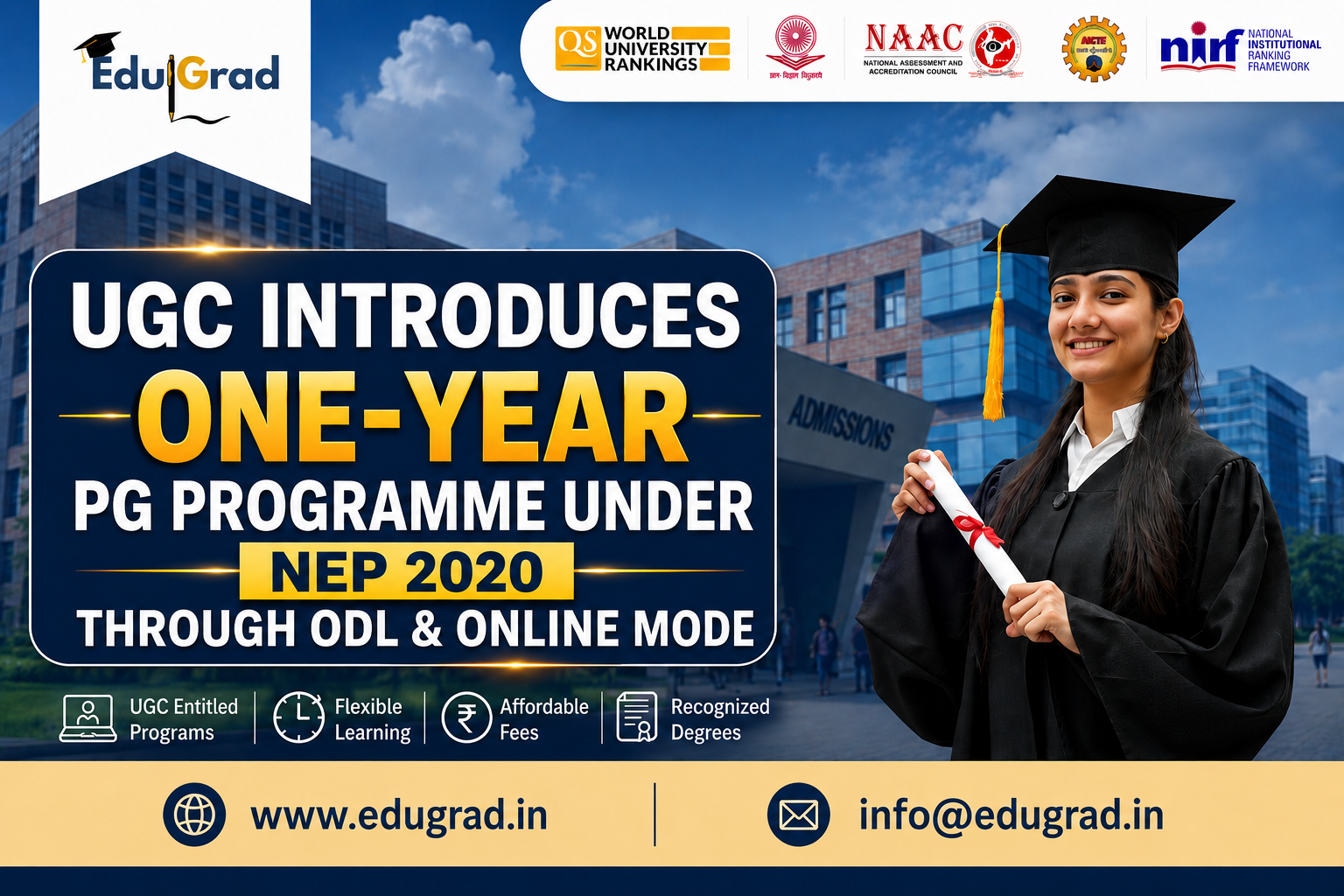
UGC Introduces One-Year PG Programme Under NEP 2020 Through ODL & Online Mode
Inquiry FormPlease enable JavaScript in your browser to complete this form.Please enable JavaScript in your browser to complete this form.Name *Email *Mobile Number *Enter Your CitySelect Course *-Select Course-Online BBAOnline B.ComOnline BAOnline BCAOnline B.ScOnline MBAOnline M.ComOnline MCAOnline M.ScOnline MA Submit Top Courses The University Grants Commission (UGC) has issued a new circular introducing the One-Year Postgraduate (PG) Programme under the National Education Policy (NEP) 2020 through Open and Distance Learning (ODL) and Online Mode. This initiative is aimed at providing students with greater flexibility and faster access to postgraduate education while maintaining academic quality and regulatory standards. The announcement is a significant step towards making higher education more accessible and aligned with the evolving needs of students and working professionals across India. Have Questions? We’ve Got Answers – Enquire Now! Download Brochure for Online MBA Download Free Online MBA Guide What is the UGC One-Year PG Programme? Under the latest UGC circular, Higher Education Institutions (HEIs) that are already approved to offer Two-Year Master’s Programmes through ODL or Online Mode can now introduce a One-Year Master’s Programme, provided they comply with all applicable UGC regulations and NEP 2020 guidelines. This programme is designed for students who have successfully completed a Four-Year Undergraduate Degree as prescribed under NEP 2020. Who is Eligible? Students can apply for the One-Year PG Programme if they: An Online MBA is suitable for: 1. Have completed a Four-Year Undergraduate Programme. 2. Meet the eligibility criteria prescribed by the respective university. 3. Apply to a university that has received UGC recognition to offer the programme through ODL or Online mode. Key Highlights of the UGC Circular 1. Introduction of One-Year Postgraduate Programmes under NEP 2020. 2. Available through Online and Open & Distance Learning (ODL) mode. 3. Applicable only to UGC-recognized universities. 4. Universities must already be approved to offer the corresponding Two-Year Master’s Programme. 5. Academic curriculum and credit framework must comply with UGC Regulations. 6. Admission is available only for eligible candidates with a Four-Year Undergraduate Degree. Benefits for Students The introduction of the One-Year PG Programme offers several advantages: 1. Faster Completion Students can complete their master’s degree in just one year instead of two, helping them save valuable time. 2. Flexible Learning The programme is available through Online and ODL mode, making it ideal for working professionals and learners who cannot attend regular classes. 3. Career Advancement A postgraduate qualification can improve career opportunities, promotions, and eligibility for higher studies. 4. Cost-Effective Education Online and distance learning programmes are generally more affordable than traditional full-time courses. Explore how career growth with MBA accelerates futures and builds strategic professionals — check out the key insights here! Important Conditions Students should note the following: The programme must strictly follow NEP 2020 and applicable UGC Regulations. Only eligible universities can offer the One-Year PG Programme. Universities must receive approval from their statutory academic bodies. All academic standards, curriculum, assessments, and credit requirements must comply with UGC norms. What Does This Mean for Students? This initiative reflects UGC’s commitment to providing flexible, accessible, and quality higher education. Students who have completed a four-year undergraduate degree will now have the opportunity to earn a master’s qualification in a shorter duration while studying through recognized online or distance learning programmes. Working professionals, fresh graduates, and learners looking to upgrade their qualifications can benefit from this new academic pathway once universities begin offering approved programmes. Get a free counseling session for Online MBA Degree from NMIMS University Enquiry Now Conclusion The introduction of the One-Year PG Programme under NEP 2020 marks an important development in India’s higher education system. By allowing eligible universities to offer one-year master’s degrees through Online and ODL mode, UGC aims to make postgraduate education more flexible, accessible, and aligned with global academic practices.Students should always verify that the university and programme are officially recognized by UGC before taking admission and carefully review the eligibility requirements announced by the respective institution. Frequently Asked Questions FAQs What is the UGC One-Year PG Programme? It is a one-year master’s programme introduced under NEP 2020 for eligible students who have completed a four-year undergraduate degree. Who can apply? Students who have successfully completed a Four-Year Undergraduate Programme and meet the university’s admission criteria. Will the programme be available online? Yes. Eligible universities can offer the programme through Online and Open & Distance Learning (ODL) mode. Can every university offer this programme? No. Only universities already recognized by UGC to offer the corresponding Two-Year Master’s Programme through Online or ODL mode can introduce the One-Year PG Programme. Is the programme approved under NEP 2020? Yes. The programme has been introduced in accordance with the provisions of the National Education Policy (NEP) 2020 and applicable UGC Regulations. Top Online MBA Specializations Online MBA in Marketing Online MBA in Human Resource Management Online MBA in Finance Management Online MBA in Business Analytics Online MBA in Data Science Online MBA in Operation Management Online MBA in Marketing Online MBA in Human Resource Management Online MBA in Finance Management Online MBA in Business Analytics Online MBA in Data Science Online MBA in Operation Management Looking for a career beyond NEET? Apply for Online MBA 2026 and build leadership, management, and business skills from anywhere.

Online MBA Admission 2026: Complete Guide to Eligibility, Fees, Last Date & Top Universities
Inquiry FormPlease enable JavaScript in your browser to complete this form.Please enable JavaScript in your browser to complete this form.Name *Email *Mobile Number *Enter Your CitySelect Course *-Select Course-Online BBAOnline B.ComOnline BAOnline BCAOnline B.ScOnline MBAOnline M.ComOnline MCAOnline M.ScOnline MA Submit Top Courses Have Questions? We’ve Got Answers – Enquire Now! Download Brochure for Online MBA Download Free Online MBA Guide Online MBA Admission 2026 If you are planning to pursue an Online MBA in 2026, this guide will help you understand everything from eligibility criteria and admission process to fees, documents, top universities, career opportunities, and placement support. Whether you are a working professional, entrepreneur, recent graduate, or someone looking for career growth, an Online MBA provides flexibility without requiring you to leave your job. In recent years, online education has gained significant acceptance in India. Many universities now offer UGC-recognized online MBA programs with live classes, recorded lectures, digital study material, online examinations, and career support. This allows learners to continue their education while managing professional and personal commitments. This guide explains every important aspect of Online MBA Admission 2026 to help you choose the right university and specialization. What is Online MBA Admission? Online MBA Admission is the process of enrolling in a UGC-approved university that offers Master of Business Administration (MBA) programs through online learning platforms. Unlike traditional MBA programs, students are not required to attend daily classroom sessions. Lectures, assignments, examinations, and study materials are available digitally. Most universities have made the admission process completely online. Students can submit their application forms, upload documents, pay fees, and receive admission confirmation without visiting the campus. An Online MBA is suitable for: 1. Working Professionals 2. Business Owners 3. Entrepreneurs 4. Government Employees 5. Fresh Graduates 6. Individuals Preparing for Career Changes Why Choose an Online MBA in 2026? There are several reasons why students prefer Online MBA programs over conventional classroom programs. 1. Flexible Learning: Students can study anytime and anywhere according to their schedules. 2. Continue Your Job: Working professionals do not need to resign from their current employment. 3. Affordable Fees: Compared to regular MBA programs, online courses generally have lower tuition fees. 4. UGC Recognition: Many universities offer UGC-recognized online MBA degrees that are widely accepted. 5. Industry-Oriented Curriculum: Modern MBA programs include practical case studies, projects, and industry-relevant subjects. 6. Career Growth: Professionals often pursue an Online MBA to improve management skills, qualify for leadership roles, and enhance career prospects. Online MBA Admission 2026 Highlights Particular Details Course Online Master of Business Administration (Online MBA) Mode Fully Online Duration 2 Years Eligibility Graduation Admission Process Online Fees ₹1,00,000 – ₹2,50,000 Top Specializations Finance, Marketing, Human Resource Management, Business Analytics, Business Management, Information Technology Management, and Operations & Data Science Management. Best For Working Professionals & Fresh Graduates Recognition UGC-Recognized Universities Explore how career growth with MBA accelerates futures and builds strategic professionals — check out the key insights here! Key Takeaways Online MBA Admission 2026 is open at many UGC-recognized universities. Working professionals and fresh graduates can apply. The course duration is generally 2 years. Fees usually range between ₹25,000 and ₹2,50,000. Popular specializations include Finance, Marketing, HR, Business Analytics, and IT Management. Most universities offer flexible online learning with live and recorded classes. Who Can Apply for Online MBA Admission? Most universities have similar eligibility requirements. You are eligible if you: 1. Have completed a Bachelor’s Degree from a recognized university. 2. Meet the minimum percentage required by the university. 3. Possess valid academic documents. 4. Have internet access for online learning. 5. Meet any additional university-specific requirements, if applicable. Some universities may also accept students with work experience for executive-oriented MBA programs. Educational Qualification Applicants must hold a bachelor’s degree in any discipline such as: 1. B.Com 2. BBA 3. BA 4. B.Sc 5. BCA 6. B.Tech Any recognized equivalent degree Most universities accept students from all academic backgrounds. Get a free counseling session for Online MBA Degree from NMIMS University Enquiry Now Minimum Percentage Required Different universities have different admission criteria. Generally: 45%–50% marks for reserved categories (where applicable). 50%–60% marks for general category in some universities. Several universities also admit students based on graduation alone without requiring exceptionally high scores. Documents Required for Online MBA Admission Students should keep the following documents ready before filling out the application form. Document Required Graduation Marksheet Degree Certificate Aadhaar Card Passport Size Photograph Signature Address Proof Category Certificate (If Applicable) Work Experience Certificate (If Required) Optional Online MBA Admission Process 2026 The admission process is straightforward and typically includes the following steps: Step 1 – Choose a University Research UGC-approved universities based on fees, curriculum, accreditation, placement support, and specialization options. Step 2 – Select a Specialization Choose a specialization that aligns with your career goals, such as Finance, Marketing, Human Resources, Operations, Data Analytics, or Healthcare Management. Step 3 – Fill Out the Application Form Complete the online application with accurate personal and academic details. Step 4 – Upload Documents Upload scanned copies of the required documents for verification. Step 5 – Pay the Application Fee Make the payment using the available online payment methods. Step 6 – Verification The university verifies your documents and eligibility. Step 7 – Admission Confirmation After successful verification, you receive an admission confirmation along with login credentials for the Learning Management System (LMS). Step 8 – Start Learning Attend live classes, access recorded lectures, complete assignments, and participate in assessments through the university’s online platform. Top UGC-Approved Online MBA Universities in India (2026) Choosing the right university is one of the most important decisions for your Online MBA journey. A UGC-approved university ensures that your degree is recognized and accepted for higher education and employment opportunities. Compare universities based on accreditation, curriculum, faculty, placement support, fees, and flexibility before applying. Top Online MBA Universities Comparison University Duration Approx. Fees NAAC Grade Key Highlights NMIMS Online 2 Years ₹2,10,000 A+ Industry-oriented curriculum, strong alumni network Amity University Online 2 Years ₹1,99,000 A+ Global recognition, modern LMS

What is the NEET Exam For?
Inquiry FormPlease enable JavaScript in your browser to complete this form.Please enable JavaScript in your browser to complete this form.Name *Email *Mobile Number *Enter Your CitySelect Course *-Select Course-B.ScBABCAB.ComBBAMCAM.ScM.ComMBAMA Submit Top Courses Admission Open for 2025 Have Questions? We’ve Got Answers – Enquire Now! Download Brochure for Online MBA Download Free Online MBA Guide NEET exam is scheduled to be conducted on 3 May 2026. If you are planning to have a career in medicine, then you must have heard about the NEET exam. NEET exam full form is the National Eligibility cum Entrance Test. NEET exam is the gateway to undergraduate medical education in India. Many students begin their preparation early, often seeking guidance from institutes like Best NEET Coaching in Sikar to improve their chances of success. But before making preparation strategies, a common question still arises is ‘what exactly is the NEET exam for?’ Understanding its purpose can help you approach your preparation with clarity and confidence. What is the NEET Exam? The NEET (National Eligibility cum Entrance Test) is a centralized medical entrance examination for undergraduate admissions in India for both Indian and foreign candidates. It is conducted annually by the National Testing Agency (NTA) from 2019. NEET is designed to streamline the admission process for a wide range of courses, including MBBS, BDS, AYUSH (BAMS, BHMS, etc.), and veterinary sciences in India. To be eligible to give the NEET exam, candidates must have completed or be appearing for their Class 12 examination with Physics, Chemistry, and Biology as core subjects. The exam is conducted in an offline (pen-and-paper) format. It comprises objective-type questions designed to assess conceptual clarity, analytical ability, and subject proficiency. Get the latest NEET Answer Key to estimate your score and analyze performance. It helps you match responses, predict results, and plan your next steps with confidence after the exam. Purpose of NEET NEET exam was introduced in 2019 to create a single, standardized entrance test for medical courses across India. NEET exam holds a significant importance in the Indian education landscape, as the score in NEET exam directly determines student’s eligibility for admission into government and private medical colleges across India. The primary goal of conducting the NEET exam is to simplify this process. It is done by offering a uniform platform for admission into all medical and dental programs. NEET exam ensures that every student is evaluated fairly on the same criteria, regardless of their background or location. Courses Covered Under NEET NEET is not limited to just MBBS admissions. It serves as the entry point for several medical and allied health programs, including: MBBS (Bachelor of Medicine and Bachelor of Surgery) BDS (Bachelor of Dental Surgery) AYUSH courses (BAMS, BHMS, BUMS, BSMS) Veterinary courses (in many institutions) Nursing and other allied programs (in select colleges) This wide scope makes NEET one of the most important exams for students interested in healthcare careers. Explore how career growth with MBA accelerates futures and builds strategic professionals — check out the key insights here! Why is NEET Important? NEET exam is highly important to all students belonging to the medical courses. One of the biggest advantages of NEET is transparency. Since the exam is conducted only in 1 shift across India by carefully considering the difficulty level of the all paper codes, hence it reduces the chances of bias or unfair practices in getting marks in the exam. It significantly reduces the unfair practices in admissions as well. NEET exam ensures merit-based selection, which is essential in a field like medicine where competence is critical. Additionally, NEET scores are accepted by both government and private colleges, as well as institutions like AIIMS and JIPMER, which previously conducted separate exams. This consolidation has made the admission process more streamlined. Who Conducts the NEET Exam? The NEET exam is conducted by the National Testing Agency (NTA), an autonomous organization established by the Government of India. NTA is responsible for maintaining the integrity, fairness, and efficiency of the examination process. The exam is usually held once a year in offline (pen-and-paper) mode and is conducted in multiple languages to accommodate students from different regions. Including smooth conduction of the NEET exam, NTA also releases the notifications, information, guidelines, and all important documents needed for conducting the examination for students. Get a free counseling session for Online MBA Degree from NMIMS University Enquiry Now Eligibility Criteria for NEET To appear for NEET, candidates must meet certain eligibility requirements set by NTA. If any student falls short in meeting the criteria, they are then prohibited to sit for the exam. The essential eligibility criteria for the NEET exam are: Must have completed or be appearing in Class 12 with Physics, Chemistry, and Biology Minimum age of 17 years at the time of admission Must meet the minimum qualifying marks in Class 12 (varies by category) There is no upper age limit as per the latest updates, making it accessible to a broader range of aspirants. Exam Pattern and Structure NEET Exam Understanding the exam pattern is crucial for effective preparation. The paper typically includes 200 questions, out of which 180 must be attempted. Each correct answer earns marks, while incorrect responses result in negative marking. NEET consists of multiple-choice questions from three subjects: Physics Chemistry Biology (Botany and Zoology) This structure tests not only knowledge but also accuracy and time management skills. Study Strategy to Crack NEET Exam Since NEET is highly competitive, preparation requires consistency and the right approach. Students often rely on NCERT textbooks as their primary resource, supplemented by mock tests and previous year papers. Coaching institutes like Matrix Academy, Allen, PCP, etc can also provide structured guidance, helping students stay on track and improve weak areas. However, self-discipline and regular revision remain key factors in success. Let us see some important strategies to crack the NEET exam: NEET primarily tests your understanding of core concepts. Begin with NCERT textbooks, especially for Biology, and ensure you thoroughly understand every topic in Physics and Chemistry.

Vineet Joshi Appointed as Interim Chairperson of UGC by Ministry of Education
New Delhi, April 2025 — In a key development in India’s higher education administration, the Ministry of Education has appointed Shri Vineet Joshi, a seasoned Indian Administrative Service (IAS) officer, as the interim Chairperson of the University Grants Commission (UGC). His appointment comes in the wake of the conclusion of Prof. M. Jagadesh Kumar’s tenure and during a period of transformative reforms under the National Education Policy (NEP) 2020. Who is Vineet Joshi? Vineet Joshi is a 1992-batch IAS officer from the Manipur cadre and a highly respected figure in Indian education policy and governance. Over the years, he has held several prominent positions in the education sector, earning a reputation for competence, innovation, and integrity. He currently serves as the Director General of the National Testing Agency (NTA), the organization responsible for conducting national-level entrance examinations such as JEE (Main), NEET (UG), and CUET (UG/PG), among others. Under his leadership, the NTA has adopted several technology-driven reforms to enhance transparency, efficiency, and fairness in examinations. Prior to his role at the NTA, Shri Joshi served as Chairman of the Central Board of Secondary Education (CBSE). During his tenure, he introduced several key academic reforms, including Continuous and Comprehensive Evaluation (CCE), skill-based education, and student-centric assessment frameworks that shifted the focus from rote learning to conceptual understanding. Why This Appointment Matters The appointment of Shri Vineet Joshi as interim UGC Chairperson holds significance for several reasons: Continuity in Reforms: India is currently undergoing a major overhaul in its higher education system as part of NEP 2020. From the implementation of the Four-Year Undergraduate Programme (FYUP) to the rollout of the Academic Bank of Credits (ABC), and promotion of multidisciplinary learning, consistent leadership is critical. Joshi’s proven administrative skills are expected to ensure continuity and momentum in these reforms. Strengthening Regulatory Oversight: The UGC is a key regulatory authority responsible for coordination, determination, and maintenance of standards of higher education. Joshi’s interim leadership is expected to bring renewed focus to regulatory efficiency and academic excellence. Technology and Testing Expertise: His experience at the helm of NTA is particularly relevant as India integrates more digital systems into education — including online learning, digital credentialing, and standardized assessments. His familiarity with ed-tech and digital reform will likely support UGC’s shift towards more tech-enabled governance. Reactions from the Academic Community Educational experts and institutional leaders have welcomed the decision, describing Shri Joshi as a steady hand capable of navigating the complex challenges facing the higher education sector. “His deep understanding of both school and higher education ecosystems positions him uniquely to bridge gaps and foster coherence in policy implementation,” said an official from the Ministry of Education. “This interim appointment is expected to ensure that the reform trajectory under NEP 2020 is not only sustained but also accelerated.” Many Vice Chancellors and academic administrators also highlighted Joshi’s collaborative leadership style and proactive engagement with stakeholders — qualities that are crucial in building trust and inclusivity in governance. Road Ahead for UGC As interim Chairperson, Vineet Joshi will oversee the Commission’s ongoing initiatives, including: Institutional accreditation and quality assurance Promotion of multidisciplinary education Internationalisation of Indian universities Expansion of access through open and distance learning Operationalization of the Higher Education Commission of India (HECI), as proposed under NEP Although this is an interim appointment, the expectations are high. His leadership during this transitional period is seen as vital to ensure smooth progress on critical policy initiatives and regulatory reforms. The Ministry of Education is expected to initiate the formal selection process for a permanent UGC Chairperson in due course. Meanwhile, Shri Vineet Joshi’s stewardship is viewed as a stabilizing force during a dynamic phase in the evolution of India’s higher education landscape. Inquiry FormPlease enable JavaScript in your browser to complete this form.Please enable JavaScript in your browser to complete this form.Name *Email *Mobile Number *Enter Your CitySelect Course *-Select Course-B.ScBABCAB.ComBBAMCAM.ScM.ComMBAMA Submit Top Universities Recent News Big B’s Granddaughter Navya gets admission to IIM Ahmedabad; Know all about BPGP eligibility, Fees CDS 2 Answer Key 2024 (OUT) Live Updates: Download Answer Key PDFs for English, GK, Maths Set A, B, C and D Big B’s Granddaughter Navya gets admission to IIM Ahmedabad; Know all about BPGP eligibility, Fees CDS 2 Answer Key 2024 (OUT) Live Updates: Download Answer Key PDFs for English, GK, Maths Set A, B, C and D Admission Open for 2025

What is ABC ID? Understanding the Academic Bank of Credits System in India
India’s higher education system is undergoing a revolutionary change—and one of the key innovations leading this transformation is the ABC ID, short for Academic Bank of Credits ID. Backed by the University Grants Commission (UGC) and a core component of the National Education Policy (NEP) 2020, the ABC ID is designed to offer flexibility, mobility, and empowerment to students across the country. But what exactly is it, and how does it work? Let’s break it down. Enquiry Now For Online MBA What is ABC ID? The ABC ID is a unique ID assigned to every student enrolled in India’s higher education system. It is linked to the Academic Bank of Credits (ABC)—a digital repository that allows students to store, transfer, and redeem academic credits earned from recognized institutions. Think of it like a digital locker for your academic achievements, accessible anytime, anywhere. The ABC ID is generated through the official ABC portal using a student’s DigiLocker credentials or Aadhaar-linked information. What is the Academic Bank of Credits (ABC)? The Academic Bank of Credits is a centralized digital platform established by the UGC to maintain a secure, real-time record of students’ academic performance in the form of credits. Key Features: 1. Credits earned from recognized institutions are digitally stored. 2. Students can accumulate credits across multiple institutions. 3. These credits can be redeemed for degrees, diplomas, or certificates. 4. Students can pause and resume education without losing progress. This system promotes flexibility in learning pathways, multi-disciplinary education, and mobility between institutions, including online and offline modes. How Does ABC ID Benefit Students? 1. Flexible Learning Students are no longer tied to a single institution. You can earn credits from one university, take a break, and resume at another without starting from scratch. 2. Credit Accumulation Whether you take a short-term course, a semester break, or transfer colleges—your credits are safe and accessible. 3. Transparency & Security Every academic milestone is recorded digitally and securely under your unique ABC ID, ensuring transparency in academic records. 4. Supports Lifelong Learning Want to switch fields mid-way? Or return to education after a few years? The ABC system allows for lifelong access to learning and credentials. How to Create Your ABC ID Creating an ABC ID is simple: Visit the ABC portal Click on “Student” and sign in using your DigiLocker credentials. Your ABC ID will be generated and linked to your academic records. Note: Your Aadhaar must be linked to your DigiLocker for authentication. Who is implementing ABC? Over 1,000 universities and colleges across India are already onboard, including central, state, and private institutions. The UGC mandates all higher education institutions to integrate with the ABC platform to enable seamless credit transfers and degree issuance. A Step Toward Global Standards The ABC system mirrors international best practices like the European Credit Transfer and Accumulation System (ECTS) and is crucial for India’s global education alignment. It supports the multiple entry and exit option in the NEP, making education truly learner-centric. Final Thoughts The ABC ID isn’t just a technical tool—it’s a powerful symbol of India’s new educational era. By giving students ownership of their learning journey and removing rigid barriers between courses, colleges, and disciplines, the ABC system is set to make Indian education more flexible, inclusive, and future-ready. So if you’re a student, don’t wait—get your ABC ID and unlock a smarter, more adaptable way to learn. Inquiry FormPlease enable JavaScript in your browser to complete this form.Please enable JavaScript in your browser to complete this form.Name *Email *Mobile Number *Enter Your CitySelect Course *-Select Course-B.ScBABCAB.ComBBAMCAM.ScM.ComMBAMA Submit Top Universities

Union Budget of India 2025: A Comprehensive Analysis
The Union Budget of India for 2025, presented by Finance Minister Nirmala Sitharaman on February 1, 2025, sets the stage for economic resilience, technological advancement, and social empowerment. With an emphasis on fiscal discipline, innovation, and inclusivity, this budget aligns with India’s long-term vision of becoming a $5 trillion economy. The union budget session witnessed intense discussions, strategic debates, and multiple rounds of expert consultations, making it one of the most dynamic financial sessions in recent history. Here’s an in-depth look at the key highlights and their implications across various sectors. The government has reaffirmed its commitment to maintaining a balanced fiscal deficit while ensuring that growth remains robust. The fiscal deficit for 2025-26 has been targeted at 5.1% of GDP, marking a gradual consolidation from previous years. Enhanced tax compliance, improved revenue collections, and strategic disinvestment in public sector undertakings are expected to contribute to this goal. Additionally, the government has maintained a steady increase in capital expenditure, with ₹12 lakh crore earmarked for infrastructure development, digitalization, and green energy projects. This is expected to drive employment, enhance productivity, and attract foreign investment. Notably, a key highlight of the budget session was the announcement of a special financial roadmap for India’s ambitious “Viksit Bharat 2047” vision, aiming to propel India into the League of developed nations by 2047. Will You Pay More or Less Tax This Year? Let’s Break It Down! One of the most anticipated aspects of the budget was the revision of income tax slabs under the new tax regime. Key highlights include: Increased Exemption Limit: The exemption limit under the new tax regime has been raised to ₹12 lakh, up from ₹7 lakh, significantly benefiting salaried individuals and small business owners. Standard Deduction Hike: The standard deduction for salaried individuals has been increased from ₹50,000 to ₹75,000. Corporate Tax Rationalization: The corporate tax rate for small and medium enterprises (SMEs) has been reduced from 25% to 22%, aiming to boost entrepreneurship and industrial growth. Simplification of GST Compliance: Measures have been introduced to simplify GST compliance for micro, small, and medium For middle-class taxpayers, this union budget brings considerable relief by reducing their tax burden. High-income earners, however, may see minimal changes in their tax outflows. Additionally, businesses—especially in the SME sector—will enjoy tax savings due to the reduced corporate tax rates. During the budget session, key opposition leaders engaged in a spirited debate over wealth tax reforms, advocating for a more progressive taxation approach to bridge economic disparities. Agriculture and Rural Development: Strengthening Self-Reliance Recognizing the significance of agriculture in India’s economy, the budget introduces several measures to enhance productivity and sustainability: Pulse Production Mission: A six-year mission has been launched to increase the domestic production of pulses like Tur, Urad, and Masoor, reducing reliance on imports and ensuring food security. Makhana Board Establishment: A dedicated Makhana Board in Bihar aims to enhance production, processing, and marketing, benefiting local farmers and promoting niche agricultural products. PM Kisan Scheme Expansion: The annual assistance under the PM Kisan Samman Nidhi scheme has been increased from ₹6,000 to ₹8,000 per farmer. Credit Boost for Farmers: Agricultural credit has been increased to ₹22 lakh crore, with special incentives for organic farming and agri-tech startups. These initiatives underscore the government’s commitment to rural prosperity and agricultural self-sufficiency. The budget session also witnessed robust discussions on climate-resilient farming, with several members advocating for increased subsidies for water conservation techniques. Science, Technology, and Innovation: Encouraging R&D India’s push towards self-reliance and global competitiveness in technology and research is evident in the budget’s increased allocation for R&D: ₹20,000 crore for Research & Innovation: The government has allocated a significant budget to encourage private sector participation in R&D across industries such as semiconductors, biotechnology, and artificial intelligence. PM Research Fellowship: 10,000 new research fellowships will be granted to scholars in institutions like IITs and IISc, fostering homegrown innovation. Quantum Computing and AI: Special incentives have been introduced for quantum computing startups and AI-driven solutions in healthcare, finance, and governance. With a focus on deep-tech and AI, India aims to lead in innovation while attracting global investments in technology sectors. During the session, the Finance Minister also announced a “Digital Bharat 2.0” initiative, aiming to enhance AI integration across public services. Infrastructure and Connectivity: Powering Economic Growth Infrastructure remains a crucial pillar of the 2025 union budget, with increased investments in roads, railways, and smart cities: National Highway Expansion: ₹2.5 lakh crore allocated for expanding and modernizing national highways, including expressway corridors and logistic hubs. Railway Modernization: ₹1.75 lakh crore set aside for high-speed rail, electrification, and station upgrades. Smart Cities and Urban Development: ₹1.2 lakh crore allocated for expanding smart city initiatives and upgrading urban transportation. Green Energy Focus: Incentives for solar and wind energy projects, along with ₹50,000 crore for clean hydrogen research and production. These investments aim to create millions of jobs while enhancing connectivity and ease of doing business. A special highlight was the introduction of “Green Corridors,” aimed at boosting electric vehicle (EV) infrastructure. Conclusion: A Vision for Growth and Stability (Union Budget) The Union Budget 2025 strikes a balance between fiscal prudence and growth-oriented policies. With strategic investments in infrastructure, agriculture, technology, and social welfare, it lays the foundation for a resilient and self-reliant economy. With its forward-looking approach, the 2025 union budget is expected to drive long-term prosperity while ensuring equitable growth across all sections of society. The budget session was marked by vibrant discussions, unexpected policy announcements, and a renewed emphasis on India’s global aspirations, making it a defining moment in India’s economic trajectory. Top Universities Recent News Big B’s Granddaughter Navya gets admission to IIM Ahmedabad; Know all about BPGP eligibility, Fees CDS 2 Answer Key 2024 (OUT) Live Updates: Download Answer Key PDFs for English, GK, Maths Set A, B, C and D Big B’s Granddaughter Navya gets admission to IIM Ahmedabad; Know all about BPGP eligibility, Fees CDS 2 Answer Key 2024 (OUT) Live Updates: Download Answer Key PDFs for English, GK, Maths